A Civilizational Laboratory
The earth seen as a living and complex organism.
Growing network of regenerative settlements.
A civilizational tissue of human inhabited cells.
Lands saturating with life and abundance of resources.
A yet unimaginable paradigm. A new earth
The emergence of planetary sentience.
We need to set about, in an orderly, sensible, and cooperative way, a system of replacing power-centred politics and political hierarchies with a far more flexible, practical, and information-centred system responsive to research and feedback, and with long-term goals of stability. Bill Mollison
We Need An Operating System
Something broke between us and the earth. It did not happen in a single century, and it will not be repaired by a single invention. The fracture runs deeper than politics or economics — it is spatial, biological, and spiritual. It is the rift between the city and the countryside, between the place where we produce our food and the place where we consume it, between the systems that sustain life and the systems we have built to ignore them. The urban-rural dichotomy is the original wound of industrial civilization, and from it flow most of the pathologies we now struggle to name: alienation, ecological collapse, epidemic loneliness, the quiet desperation of commuting hours each day through landscapes stripped of meaning.
Many people consider leaving cities if there were a viable alternative. But the options are polarizing: the metropolis with its stimulation and opportunity, or the small town with its silence and limitations. What if that binary were false? What if there existed a third way — a settlement that held the magic of the city while keeping intimate contact with the living soil? What if children could walk to school through orchards, workshops hummed within earshot of greenhouses, and everything you needed stood within ten blocks of your front door?
This essay describes such a settlement. Not as utopian fantasy, but as an engineering specification, an economic model, a governance protocol, and a replicable organism — all integrated into a single open-source framework called Rubania, now crystallizing into its most ambitious expression: GaiaSapiens.
The name is a declaration. For two hundred thousand years we have called ourselves Homo sapiens — the wise human. GaiaSapiens shifts the locus of wisdom from the individual to the whole. The earth is wise. The biosphere is the teacher. And those who learn to design with it, rather than against it, constitute a new species of civilization — one that can spread across the globe like living tissue, leaving fertility in its wake.
No single system, no artificial intelligence, no robot can return to us what we have lost: our oneness with the web of life. But this time we have matured. We can design ecosystems in harmony with us and make use of technology without being enslaved by it. We can create an anthroposphere in symbiosis with the earth. We can be part of something precious.
The idea that countryside and city might coexist in a single space was first articulated by Singaporean architect Tay Kheng Soon, who called it rubanisation — a portmanteau of "rural" and "urban." His vision was not of suburbs, nor of garden cities in the Ebenezer Howard tradition, but of something more radical: a living web spread over valleys and waterways, coexisting with farms and plantation forests, punctuated by clusters for education, entertainment, and manufacturing. Every settlement high-density but low-rise. Bicycles and walking as the primary modes of movement. Spatial efficiency tied to human convenience, not automotive throughput.
Tay Kheng Soon understood that the urban-rural divide was not merely a planning failure but a neurological one. Industrial civilization had privileged the left hemisphere of the brain — the logical, calculative, egoistical — at the expense of the right — the holistic, aesthetic, empathetic. Healing the spatial rift between city and countryside required a parallel healing of the human psyche, a rebalancing of our internal architecture alongside our external landscape.
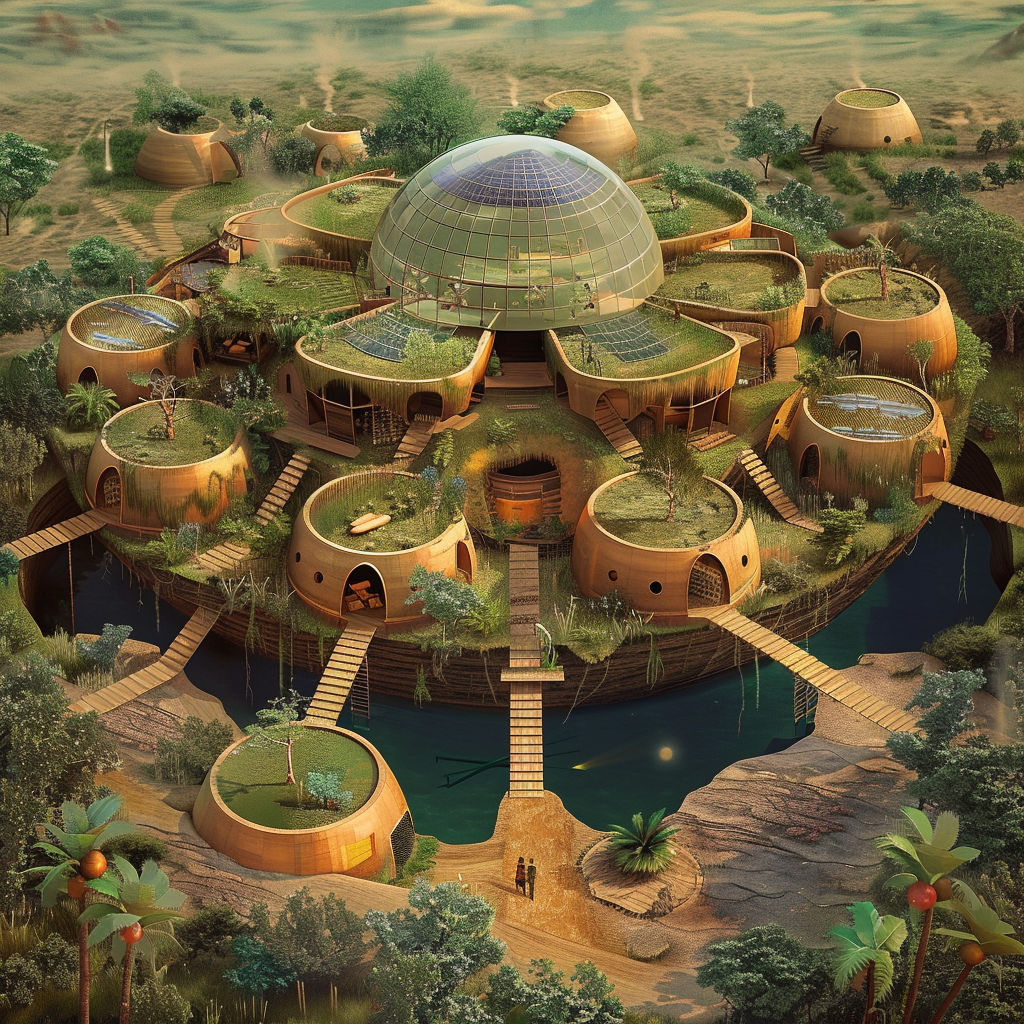
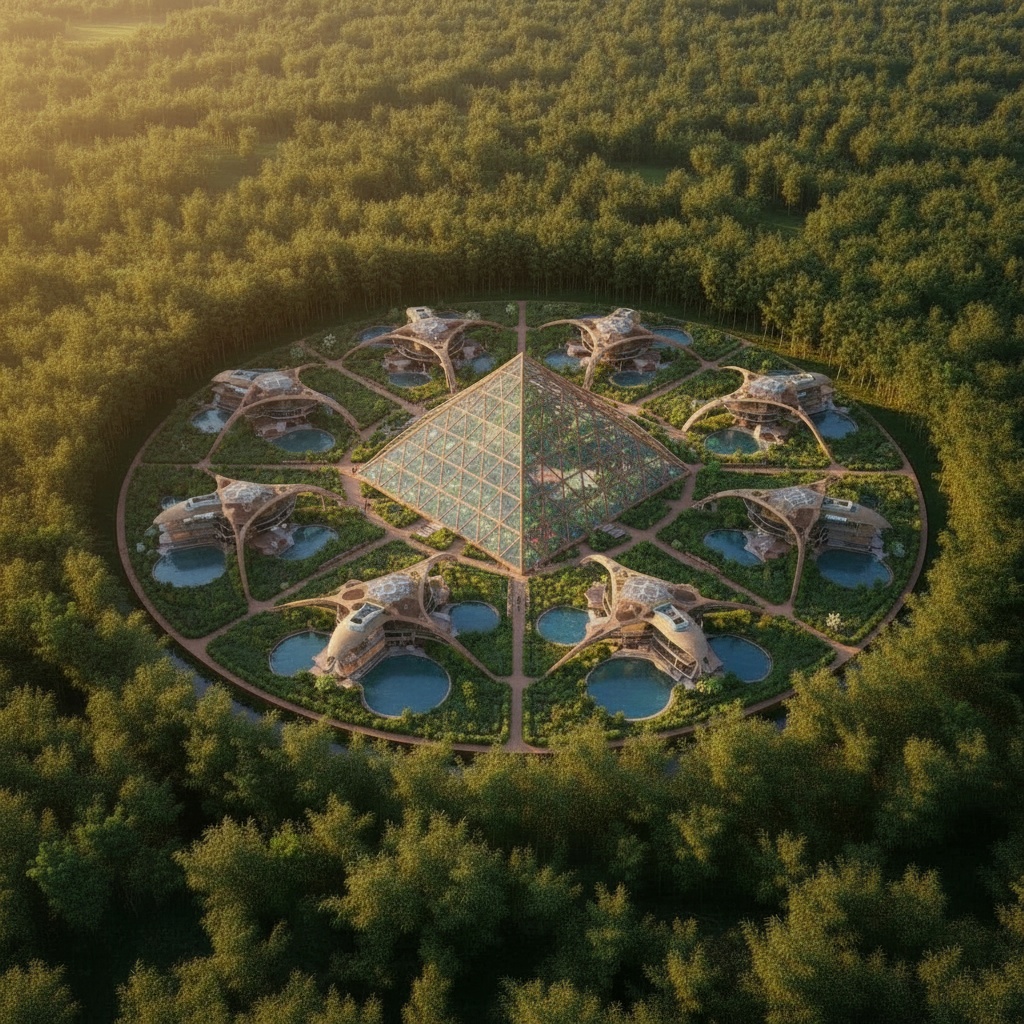
Rubania inherits this insight and operationalizes it. A rubanised cell is a community of roughly one thousand people that integrates urban amenities — workshops, schools, clinics, agoras, digital infrastructure — with agricultural productivity, native biodiversity corridors, and energy autonomy. There are no automobiles inside it. Water reservoirs abound. The landscape is filled with productive trees and ecological housing. Children walk to school without danger. The settlement sits within a five-hundred-metre radius — optimal walking distance — and everything anyone needs exists within it.
The forest is the city. Settlements are not "built in" nature — they emerge as part of it. The gradient between inhabited space and wild surroundings is gentle, without fences, seeking harmony and symbiosis with the biome.
This is not pastoral escapism. It is a design science. The tools come from permaculture, the ecological design framework initiated by Bill Mollison and David Holmgren. Permaculture provides the ethics — care for the earth, care for people, fair share of resources — and the pattern language: observe and interact, catch and store energy, obtain a yield, design from patterns to details, integrate rather than segregate, use edges and value the marginal, creatively respond to change. These are not slogans. They are engineering heuristics tested across forty years and millions of hectares of working landscapes.
The philosopher Arthur Koestler coined the word holon to describe an entity that is simultaneously a whole in itself and a part of something larger. A cell is a whole organism, and also a part of a tissue. A tissue is a whole, and also part of an organ. Ken Wilber extended this into a comprehensive framework: the world is composed not of atoms, symbols, or concepts, but of holons — nested wholes within wholes, each maintaining self-preservation (agency), self-adaptation (communion), self-transcendence (emergence), and the capacity for self-dissolution.
Rubania is built on holonic architecture. Every scale is autonomous. Every scale is also a part of the next. And the rules governing each scale echo fractally through the entire system.
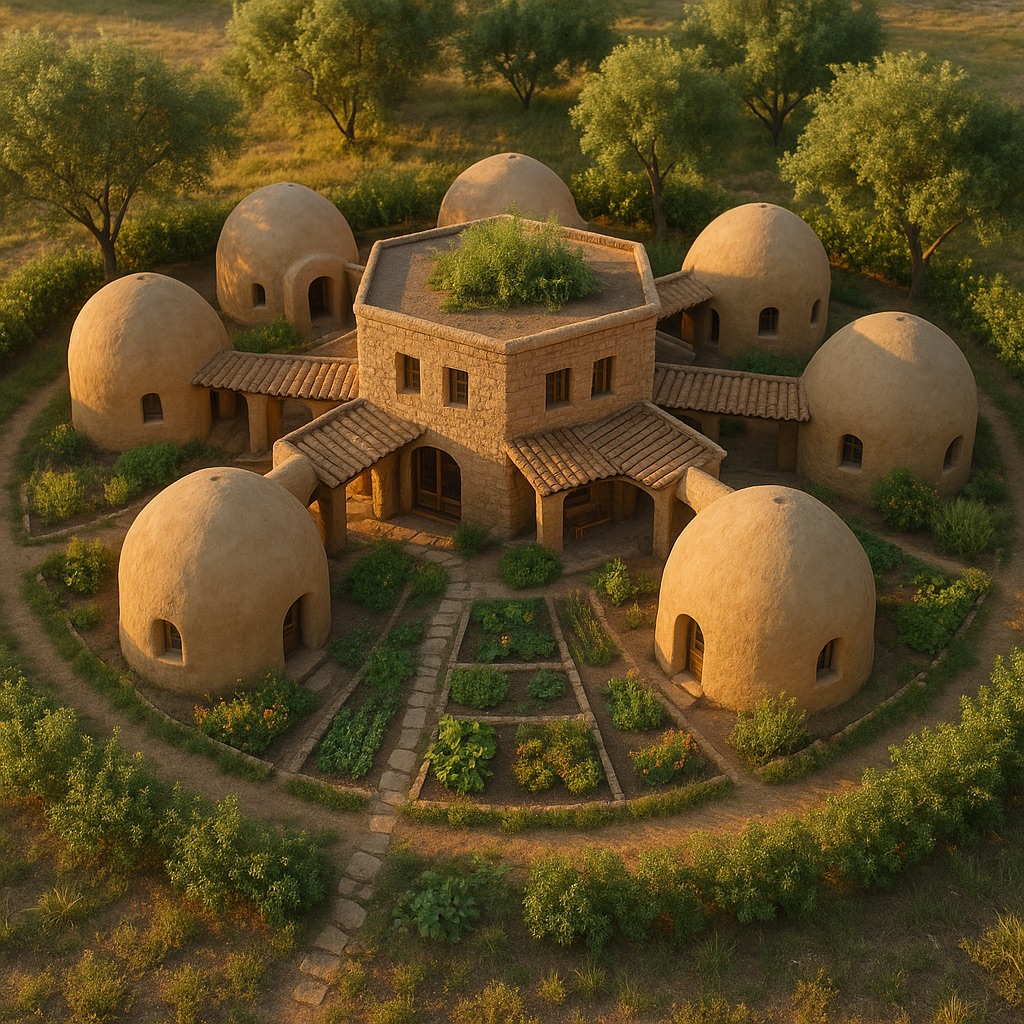
The irreducible unit is the Compound Home — an extended family dwelling for eight to twelve people, arranged as a ring of six adobe domes around a central core. The core is the social anchor: kitchen, workshop, and greenhouse. Energy — electricity, hot water, and space heating — is supplied by the Guild's central reactor. The six outer domes are private — bedrooms, pantries, composting toilets — each connected to the core by short covered walkways. The arrangement creates privacy gradients: from the intimate dome interior, through the semi-public core, to the communal space beyond. No one is ever more than a few steps from both solitude and society.
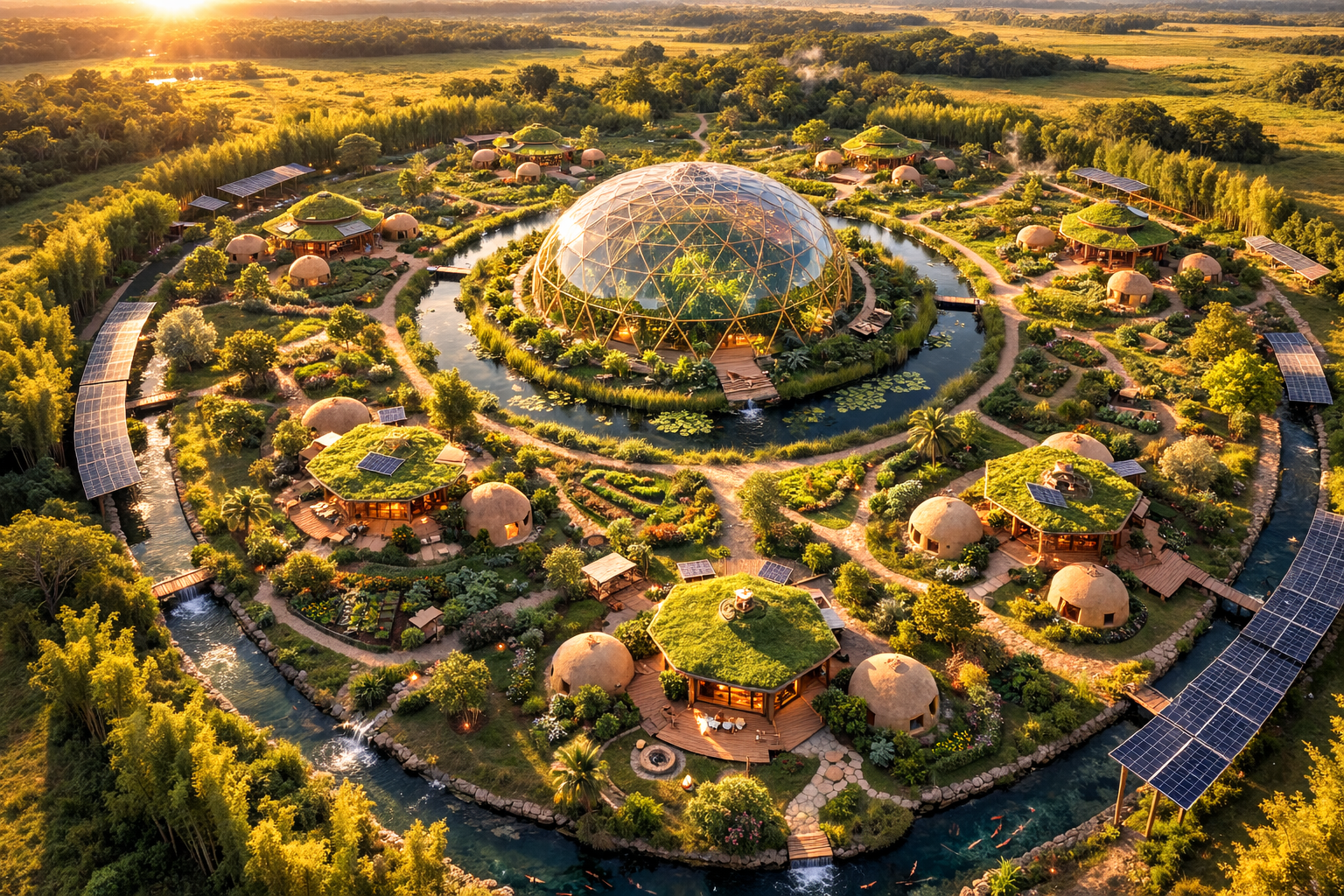
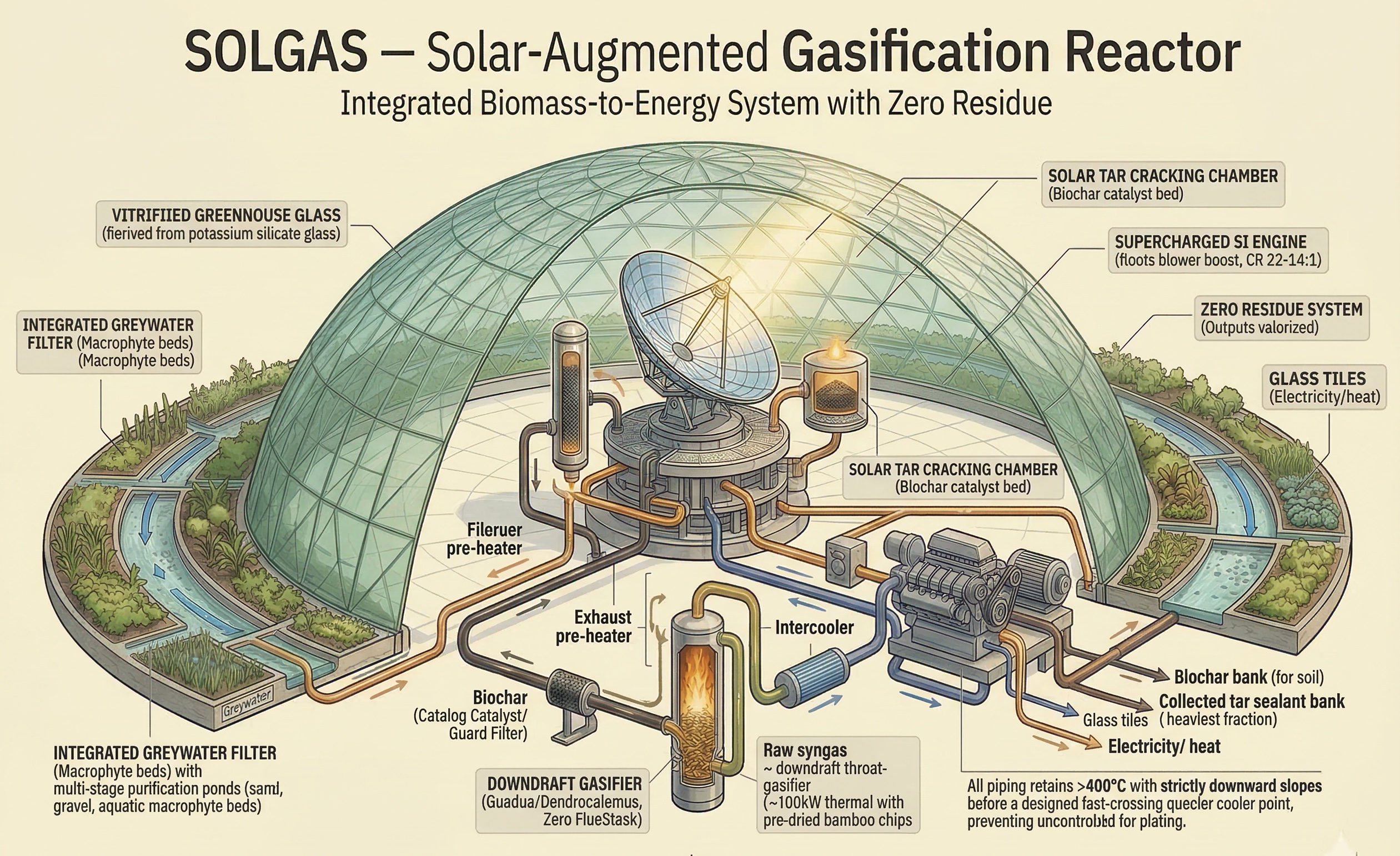
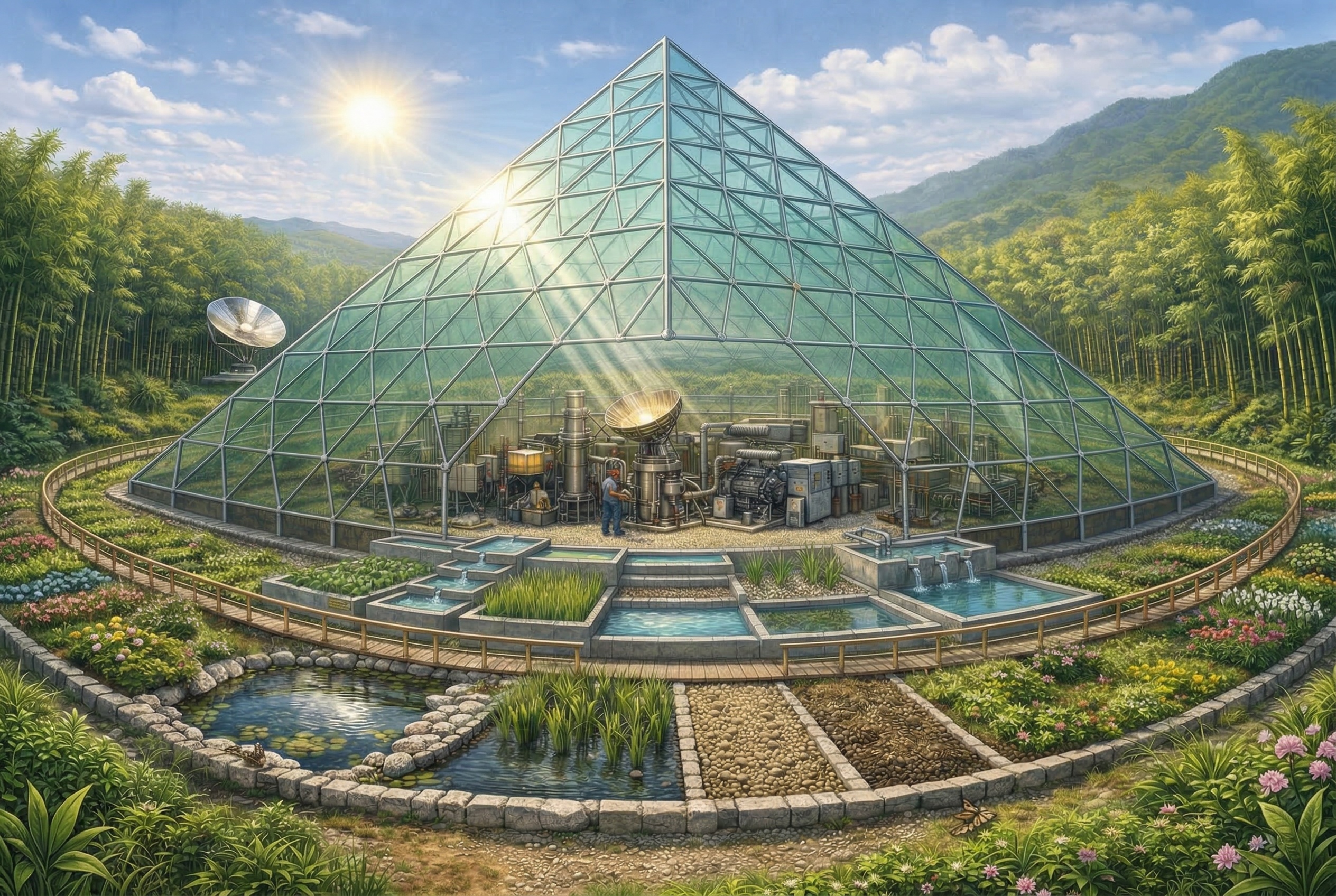
The compound receives hot water from the Guild's central reactor via a distributed heating loop, cascading through radiant floors for space heating, drying chambers, and domestic hot water. The greenhouse — located at the Guild hub, not within individual compounds — houses the reactor at its centre, functioning as a solar trap. Flue gas CO₂ enriches crops. Bamboo ash feeds glass production. Bamboo tar preserves structural members. Nothing exits the system as "waste" — everything is input to another process.
Eight compounds cluster around a shared hub to form a Guild — roughly ninety-six people cooperating through shared infrastructure while maintaining individual autonomy. The name comes from both permaculture's plant guilds (groups of species that mutually benefit each other) and medieval craft guilds (associations of artisans). A Guild is a neighbourhood-scale organism where specialised households cooperate, but where no shared dependency could compromise any single compound's survival.
The Guild hub is where the system's elegance becomes visible. A fifty-kilowatt downdraft gasifier converts bamboo into syngas that drives a generator, producing electricity for homes and the guild workshop while its waste heat cascades through greenhouse floors, domestic hot water, and biomass drying. Fifty kilowatt-peak of elevated solar panels provide complementary electricity while shading livestock beneath them, cooling the trout canal, and collecting dew. Solar surplus powers a compressor that produces ice — a thermal battery stored in insulated tanks for cold rooms, transport, and aquaculture.
Every element serves multiple functions. Every problem is reframed as a solution. The more energy the system produces, the more vegetables it grows — without losing water — while creating convection and CO₂ enrichment in the process.
The gasifier is not merely a power plant. It is the metabolic core of the Guild. Its ash, rich in silica, is melted in a solar concentrator to produce glass aggregate for construction. Its tar — vegetal creosote — coats the bamboo structural members, extending their lifespan from five years to fifteen. Its exhaust CO₂, filtered through a three-way catalyst and released at canopy level inside the greenhouse, boosts crop yields by twenty to thirty percent. Its biochar — twelve percent of dry biomass input — returns to soil as a permanent carbon sink and soil amendment. Even the excavation spoil from underground chambers becomes adobe wall material. The waste-to-resource map is total.
A circular trout raceway runs through the Guild landscape, producing five to ten tonnes of premium protein per year. Trout effluent becomes greenhouse fertigation. Greenhouse produce feeds people. People maintain the systems. The loop closes. Revenue from trout, organic produce, education, and hospitality gives the Guild's capital investment a payback period of three to five years.
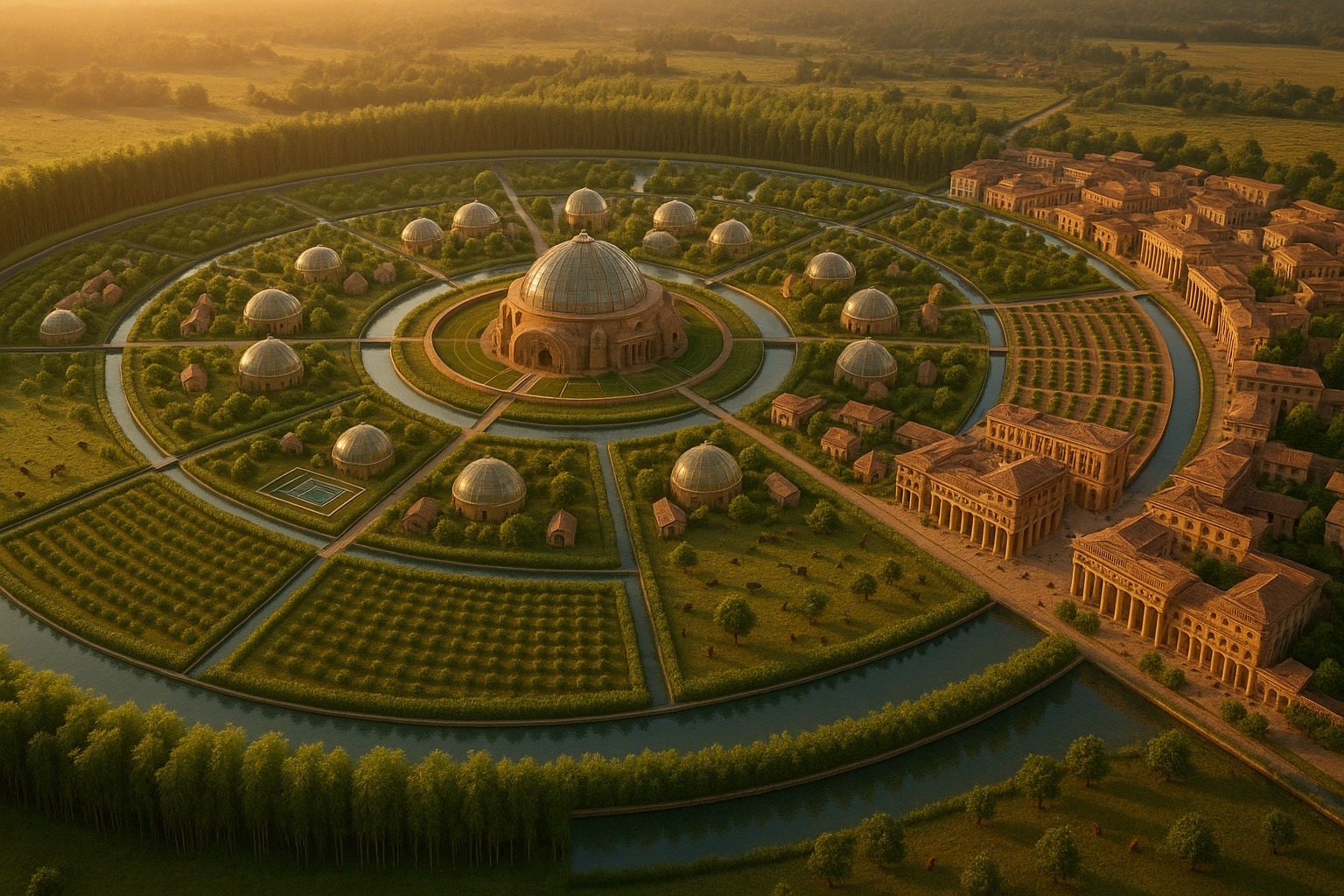
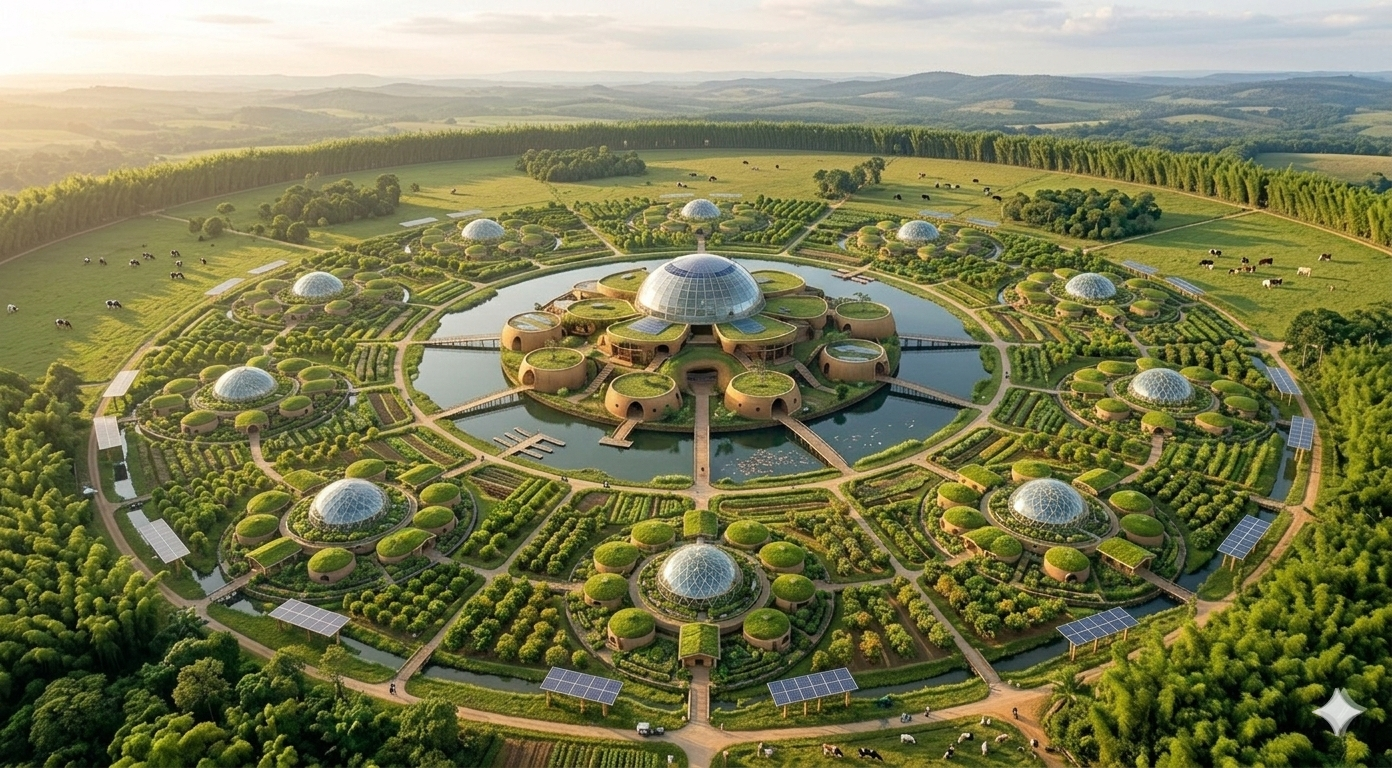
Multiple Guilds compose a Cell — the full civilisational unit. Approximately one thousand people, self-governing, with its own commons, governance, education, health, and culture. The Cell follows permaculture zoning: at its centre, the Educational Institute and agora (Zone 0); radiating outward, compound homes and intensive gardens (Zone 1), food forests and silvopasture (Zone 2), extensive production and rotational grazing (Zone 3), managed forest and bamboo groves (Zone 4), and finally wild nature merging into ecological corridors (Zone 5). The gradient from settlement to wilderness is continuous, unbroken by fences — a landscape where the forest is the city and the city is the forest.
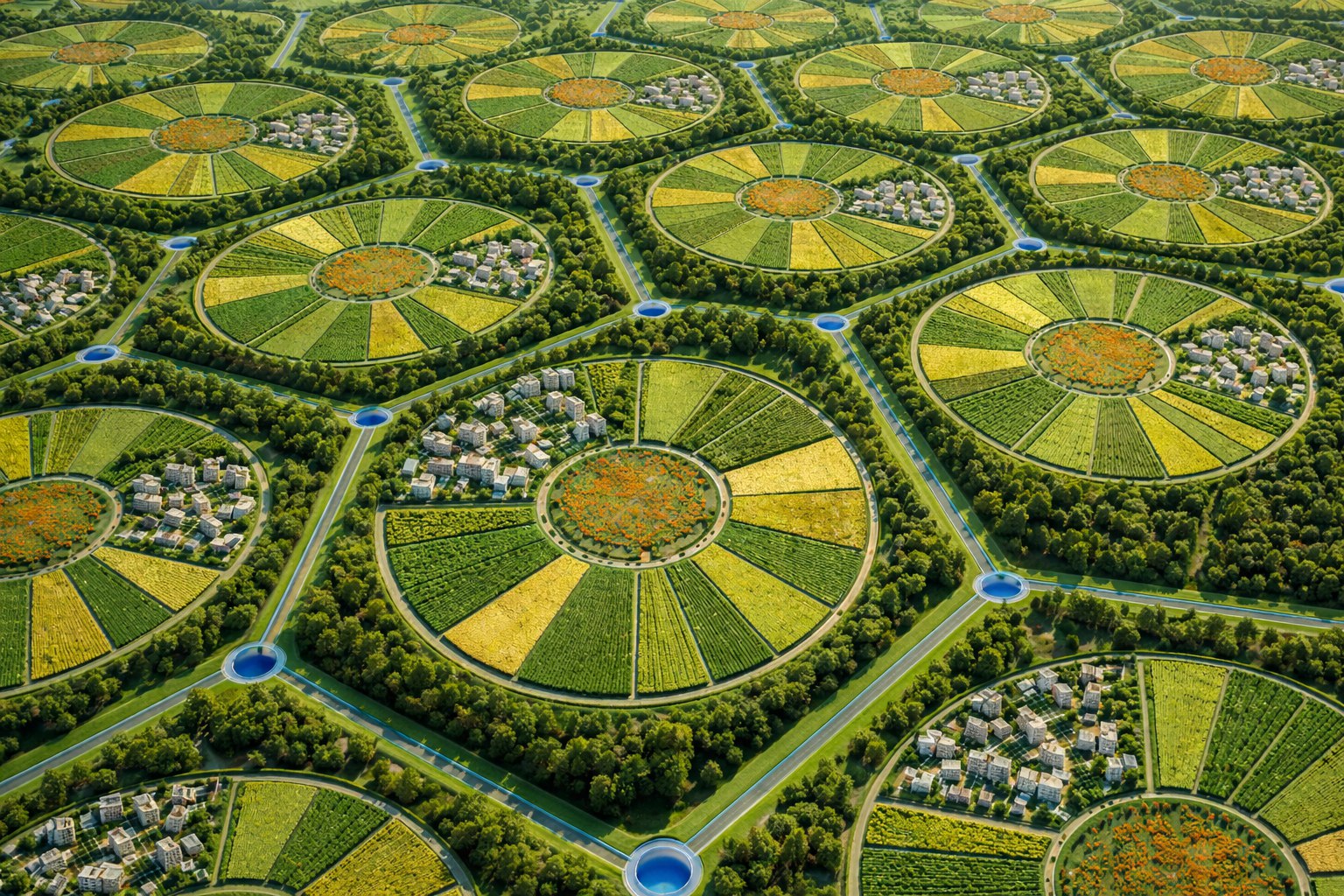
Cells do not exist in isolation. They interconnect through native natural corridors — biodiversity highways where wild populations maintain genetic connectivity, ecosystem services flow to adjacent settlements, and new cells can germinate organically. This is the Reticular Fabric: a planetary tissue of regenerative human settlements, tessellated by pristine corridors where wildlife and the biome can breathe and embrace us.
The physical body has a digital nervous system: the Ruban Operating System (R.O.S.), a federated protocol that coordinates inter-cell movement of people, trade, knowledge transfer, and the big-picture metrics of how thousands of cells collectively form what the framework calls "a civilised biodiversity organ spread across the face of the earth." The R.O.S. does not control cells; it enables their interaction, just as a nervous system enables organs without commanding them.
The most common failure mode of intentional communities is not financial or agricultural — it is political. Small groups concentrate heavy work in few hands. Those few make all important decisions. They become unhappy "ego-villes" rather than eco-villages. The founders burn out, the idealists disillusion, and the community collapses into precisely the hierarchies it set out to escape.
Rubania confronts this squarely. Its governance model is neither pyramidal hierarchy nor flat horizontalism. It is a holacracy — a distributed governance system inspired by Brian Robertson's organisational framework, adapted from the corporate context to the community context and fused with liquid democracy.
In holacracy, the seat of power shifts from the person at the top to a process defined in a written constitution. Roles — not people — are the organisational units. People fill multiple roles based on credentials and capacity, not permanent titles. Nested circles (compound → guild → cell) each maintain autonomy in their domain while coordinating with others. Governance meetings are tension-driven: topics enter the agenda when any member senses a gap between how things are and how they could be. Minority voices always retain the ability to correct course.
We need to set about, in an orderly, sensible, and cooperative way, a system of replacing power-centred politics and political hierarchies with a far more flexible, practical, and information-centred system responsive to research and feedback, and with long-term goals of stability.
Bill Mollison
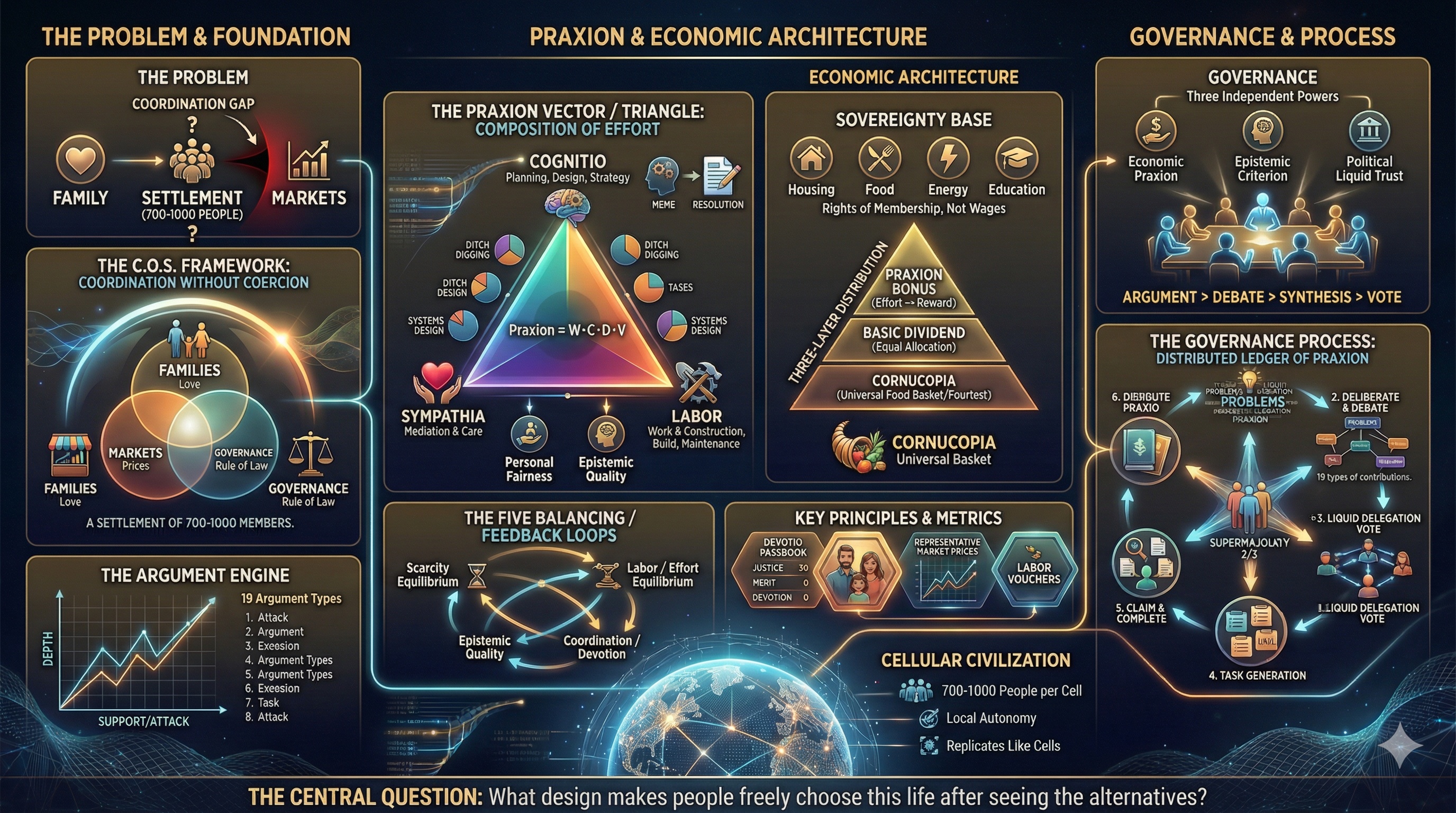
Complementing the organisational structure, liquid democracy handles policy and priorities. Each member can vote directly on issues they understand and care about, or delegate their vote to a trusted person on specific topics — an engineer for energy questions, a teacher for education policy, a medic for health decisions. Delegation is revocable at any time, and vote weight is modulated by demonstrated contribution, not wealth. This is meritocracy of effort, not plutocracy.
But voting alone is not enough. Uninformed voting is worse than no voting at all. This is why the Cell O.S. — the human coordination software that runs each cell — integrates structured deliberation before every decision. Argument maps visualise the "because" and "but" structure of any debate. Perspective-avatars allow members to explore issues through multiple stakeholder viewpoints. Only after the deliberation cycle completes does the community vote — and at the close of each economic period, a Merkle checkpoint — a cryptographic hash compressing all votes, delegations, and argument map states — is anchored to the Bitcoin blockchain via OP_RETURN. The democratic history is permanent, auditable, and incorruptible.
The result is what the framework calls a constitutional merit republic: authority flows from demonstrated competence within scoped domains, checked by elder review, influence decay, and anchored transparency. No rulers. No ruled. Just process.
Traditional economics offers two failed extremes. Market capitalism reduces all human effort to a commodity price — efficient but soulless. Egalitarianism gives everyone the same regardless of contribution — fair in theory, corrosive in practice. Both fail because they flatten the multidimensional reality of human effort into a single number.
Rubania's economic system — what it calls Gift Economy 2.0 — preserves what works in both while fixing what doesn't. From capitalism: individual agency, property rights, economic incentives, the price signal. From gift economies: recognition that human labour cannot be fully commodified, that context matters, that relationships have intrinsic value. The innovation is a system with memory, texture, and justice.
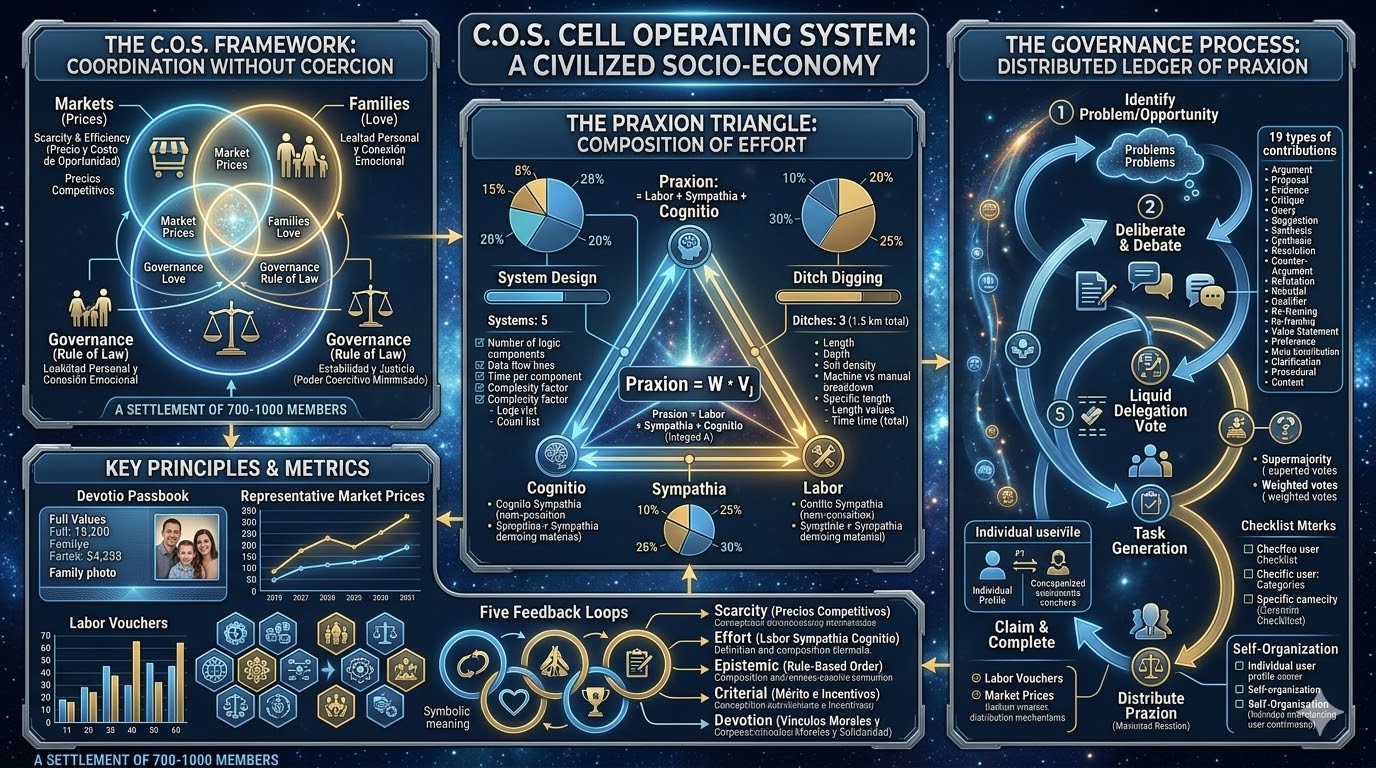
At the heart of the economy lies the Praxion — a three-dimensional vector inspired by Ludwig von Mises' praxeology (the study of human action). Every task is registered not merely by duration, but by the texture of effort it demands across three internal dimensions: Cognitio (intellectual effort), Sympathia (empathy, emotional labour, care), and Labor (physical exertion). Time acts as a scalar multiplier, producing a Praxion Tempus — the actual unit of registered effort. A separate Volition Coefficient (Vj), derived from behavioural signals such as initiative, leadership, and consistency, modulates the final value from outside the vector — capturing the will behind the work without allowing self-declaration.
Designing a water system might register as heavy Cognitio with light Labor. Mediating a conflict is heavy Sympathia. Digging an irrigation trench is heavy Labor. Teaching at the Earth School blends Cognitio and Sympathia. No two tasks look the same in Praxion space, because no two tasks are the same in human experience.
At the close of each economic period, the system aggregates all Praxion vectors across all members. The proportion of each dimension in the total reveals what was scarce and what was abundant. If the community leaned heavily into cognitive work, anyone who contributed empathic or physical labour receives a better exchange rate — because it was rare and needed. Next period, if many people shift to emotional labour, something else becomes scarce. The system self-corrects, continuously, without decree or negotiation. Value emerges from the actual pattern of what the community does, not from what a committee thinks it should do.
Two people performing the same task have the same Praxion vector. But if one is neglecting family and health while the other has no such sacrifice, the Sacrifice Coefficient — called DEVOTIO — adjusts the reward to reflect the true personal cost. DEVOTIO is a peer-recognition multiplier: colleagues, family members, and coordinators signal when someone's contribution involves exceptional personal sacrifice. You cannot claim you are sacrificing everything if the people around you do not confirm it.
DEVOTIO also functions as an early warning system. Consistently high scores on health and family sacrifice surface an alert — not to punish, but to redistribute roles and provide support before burnout occurs. The economy thus becomes a wellbeing monitor, not merely a ledger.
Each member's conversion of effort to reward combines three inputs: their individual Praxion profile (what dimensions they contributed), the period's emergent weights (what was scarce), and their DEVOTIO coefficient (what it cost them personally). No two people have the same exchange rate. This is not inequality — it is distributive justice.
Revenue flows into the Treasury System, where emergent weights determine allocation. Members choose each period whether to redeem their accumulated actions for Ruban Cash (the internal currency, backed one-to-one by real foreign currency surplus) or accumulate them as growing equity in the cell's future. Individual economic agency within a cooperative framework. Capitalism with a soul.
Bill Mollison once observed that the problem is not the community — it is the people. What we need is a people system. The Cell O.S. takes this literally. It is an integrated software framework that enables self-governance, economic justice, transparent deliberation, and personal development within each cell. It manages resources, capital, education, food sovereignty, and the revenue generated by everything the community produces and offers.
The Cell O.S. interface is built on Ken Wilber's four-quadrant AQAL model — a cross dividing the screen into four sectors. Upper-left: the "I" quadrant, where each member's Vitruvian Layers identity system tracks biological health, credentials, peer perceptions, and personal growth. Upper-right: the "IT" quadrant, where the Word Cloud Hierarchy organises the cell's seventeen ministry areas and argument maps structure every live debate. Lower-left: the "WE" quadrant, where the Hands of Exchange matching engine connects what people can give with what people need. Lower-right: the "ITS" quadrant, where the physical cell — infrastructure, energy, agriculture, spatial design — is modelled and monitored in real time.
At the centre point, where the four quadrants meet, sits the Treasury dashboard — the economic heart. And every subsystem feeds every other subsystem: work registered as Praxion flows into emergent pricing, which flows into the treasury, which flows into Ruban Cash, which flows into the hands of exchange, which surfaces new tensions in the word cloud, which triggers argument maps, which lead to informed votes, which adjust roles in the holacracy, which redistributes work, which generates new Praxion vectors. The loop is continuous, self-correcting, and anchored to the Bitcoin blockchain at every critical juncture.
The Cell O.S. is open source. Every line of code is publicly auditable. Its architecture is peer-to-peer, resilient to network failures, and beholden to no central authority. It is, in Mollison's words, a practical and information-centred system responsive to research and feedback. And it is the minimum viable product for the entire Rubania project. Before any land is purchased, before any earthworks begin, the Cell O.S. models the cell virtually — allowing future residents to debate, design, vote, and organise in the digital realm before committing to the physical one.
A settlement that depends on external energy is not autonomous — it is a hostage. The Guild Energy Module is designed for complete energy sovereignty using locally grown biomass, passive solar, and appropriate technology that any trained person can maintain and repair.
The fuel is bamboo — specifically Guadua angustifolia, one of the fastest-growing plants on earth. A managed bamboo plantation yields fifteen to twenty-five dry tonnes per hectare per year, requires no replanting (it is harvested selectively from a perennial stand), and simultaneously serves as building material, windbreak, carbon sink, and erosion control. Three hectares of bamboo sustain the Guild's fifty-kilowatt gasifier indefinitely — roughly fifty kilograms of sun-dried chips per hour, pre-dried to five percent moisture content in a waste-heat chamber before feeding the reactor.
The gasifier converts bamboo into syngas through four thermal zones — drying, pyrolysis, oxidation, and reduction — at temperatures reaching twelve hundred degrees Celsius. The syngas drives a supercharged gas engine at thirty percent electrical efficiency. Exhaust heat cascades through multiple destinations: radiators for compound heating via a distributed hot-water loop, biomass pre-drying chambers, domestic hot water, and the greenhouse interior where the reactor sits at the centre as a solar trap. The flue gas — filtered through a three-way catalyst — delivers clean CO₂ at canopy level, boosting crop yields by twenty to thirty percent. Biochar (twelve percent of dry biomass input) returns to soil as a permanent carbon sink. Bamboo tar preserves structural members. The system operates on a gravity cascade principle: human intervention is limited to loading bamboo at the surface. Everything else flows downward automatically.
Moat-mounted agrivoltaic solar panels provide a second electricity stream while performing triple duty: shading the trout canal (maintaining cold-water temperatures), shading pasture and walkways, and collecting rainwater and dew. Solar surplus powers a compressor that produces ice, storing temporal energy abundance as cold — a thermal battery that serves cold rooms, transport refrigeration, trout canal cooling, reactor air-intake pre-cooling, and greenhouse condensation year-round. At just twenty percent moat coverage the array produces more than enough for all ice needs, with surplus powering the guild workshop and charging portable tool batteries during daylight hours.
Solar surplus from the guild's moat-mounted agrivoltaic array powers a compressor that produces ice — a thermal battery stored in insulated chambers. That ice cools the trout raceway, preserves meat for market, enables a cold chain for premium sales, recovers moisture from greenhouse air through a condensation coil at the dome apex, pre-cools reactor air intake, and serves as a thermal reserve for peak demand. A single element — ice — performs six functions. Meanwhile, a separate distributed cooling circuit places compact DX coils at each compound's earth-tube inlet, powered by a local section of moat PV, reinforcing passive cooling in summer. This is the principle of stacked functions taken to its logical conclusion: every element serves multiple purposes, and every important function is served by multiple elements.
The gasifier is not just a power plant. It is the metabolic core of the Guild — where energy production, food growth, material fabrication, and waste processing converge into a single living system.
The cell's centre is not a marketplace or a government building. It is a school. The Central Educational Institute is the axis around which familial, commercial, and cultural dynamics orbit. It is not merely a place where children learn to read — it is the primary engine of the cell's replication strategy.
The pedagogy is integral: inspired by Montessori's respect for the child's natural development, Waldorf's integration of arts and practical skills, and the hands-on ecological immersion of permaculture education. Students learn bioarchitecture by building with bamboo and adobe. They learn energy systems by maintaining the gasifier. They learn economics by participating in the Praxion system. They learn governance by voting in their own school circle within the holacracy. By the time they graduate, they carry within them the complete pattern language of a regenerative settlement.
This is the replicability principle in action. Each cell is a training ground. Graduates found new communities. Success is not measured by how many bricks have been laid in one place, but by the system's ability to replicate — to send trained teams out into the world to establish new cells, expanding the Reticular Fabric with each generation. One cell becomes tissue. Tissue becomes a planetary network.
How does one begin? Not with a blueprint and a bulldozer, but with a gathering. The Breathing Land Festival — now evolving into the first GaiaSapiens gathering — is the catalyst that transforms strangers into pioneers.
The festival is not a celebration of what exists. It is a foundational act — an agora, a civilisational laboratory, a congregation of people who arrive at a potential site and begin building the first infrastructure with their own hands. Composting toilets built during the first weekend. Communal kitchens assembled from local materials. Workshop tracks running in parallel with open space, communal meals, and the slow, essential process of discovering who you want to build a life with.
The festival iterates annually at the same site, each year leaving more permanent infrastructure behind: earthworks, plantings, water systems, the first greenhouse, the first compound prototype. Gradually, the festival merges with the settlement. The line between gathering and inhabiting dissolves. Some attendees return as residents. The Breathing Land becomes a living place.
Investment tokens — IOU.LAND for site selection, IOU.HOUSE for housing usufruct — channel crowdfunded capital into land acquisition and construction, all managed through the Cell O.S. with full transparency. The Community Land Trust ensures that no individual can speculate on the land's appreciating value. You can invest in a home; you cannot flip the commons.
It must be said plainly: there is no algorithm that can restore our belonging to the web of life. No artificial intelligence can substitute for the feeling of soil between fingers, the sound of rain on a greenhouse roof, the wordless understanding that passes between people who have built something together with their hands. Technology is a tool, not a saviour. And the history of tools is a history of trade-offs — fire warms and burns; the plough feeds and erodes; the internet connects and isolates.
GaiaSapiens does not reject technology. It domesticates it. The Bitcoin blockchain is not a buzzword — it is the minimum viable mechanism for transparent, incorruptible record-keeping in a community that refuses to concentrate trust in any single authority. Solar panels are not green ornaments — they are shade structures for livestock that happen to produce electricity and ice. Every technology in the system must pass a triple test: does it serve a biological function? Is it locally repairable? Does it create dependence, or does it dissolve it?
The appropriate technology philosophy runs deeper still. Information technology is essential for self-organisation, so its energy supply must be rock solid — a distributed mesh of cross-connected energy stations with no single grid that can fail. Solid-state storage, peer-to-peer networking, each node both client and server. The digital infrastructure mirrors the biological: distributed, redundant, resilient, and locally owned.
We have matured. We can design ecosystems in harmony with ourselves and make use of technology without being enslaved by it. We can create an anthroposphere in symbiosis with the earth.
Everything described in this essay — the holonic architecture, the gasification systems, the Praxion economy, the liquid holacracy, the Cell O.S., the bamboo greenhouses with their solar-vitrified glass, the trout raceways and silvopastures and solar ice systems — all of it is open source. The blueprints, the code, the pattern language, the financial models: freely available to anyone on earth who wants to establish a new cell.
This is the decisive design choice. Rubania is not building one community. It is building the seed — a replicable, self-documenting organism that carries within it the complete instructions for its own reproduction. Like a biological cell that divides by encoding its entire genome in each daughter, every GaiaSapiens settlement graduates pioneers who carry the full pattern language to new sites, new climates, new cultures. The specific crops change. The building materials adapt. The governance constitution is amended by each new community. But the underlying architecture — holonic, distributed, regenerative, transparent — persists and evolves.
The online Ruban Design tool will invite thousands of collaborators to co-create new patterns for settlement design before any physical construction begins. Winning designs are funded through cooperative investment and community land trusts. Real communities are built from collectively validated blueprints. The internet — so often a force for alienation — becomes the collaborative substrate for a new kind of placemaking.
The vision of Tay Kheng Soon returns at planetary scale: a reticular fabric of cells interconnected by ecological corridors, each cell a whole and a part, each corridor a breathing space where the biome regenerates. The Ruban Operating System coordinates this tissue — not commanding, but enabling. Biodiversity data aggregated across continents. Demographic flows mapped. Replication velocity tracked. A planetary coordination layer for a species that has finally learned to coordinate without coercing.
This is not naïve optimism. It is the product of eighteen years of research, design, calculation, and the stubborn conviction that human beings — given the right tools, the right structures, the right incentives — will choose cooperation over extraction, stewardship over plunder, complexity over simplification. The evidence from permaculture, from holistic management, from the intentional communities movement, from distributed systems engineering, all points in the same direction: the solutions exist. What has been missing is a way to integrate them into a coherent, replicable whole.
GaiaSapiens is that integration. It is a civilisational laboratory. It is a social experiment. It is a collaborative but lucrative endeavour. It is a new paradigm of human living. It is a regenerative, fertile, and thriving settlement. It is a voyage to a new earth. It is a tour de force. It is our nature, our nurture, our mothership in harmony. It is the search for an autopoietic system for all earthlings. It is a spark that can spread around the globe. It is a human tissue covering the earth organism. It is a new life.
And beyond the horizon, once we have learned to live in symbiosis with our own planet — to build settlements that regenerate rather than deplete, to govern ourselves without coercion, to distribute justice through systems rather than ideology — we will have earned something that no amount of rocket fuel alone can provide: the wisdom to carry life to other worlds without repeating the mistakes we made on this one.
The rise of GaiaSapiens is not an end. It is a beginning. The way to the stars passes through the soil beneath our feet.